Thursday, April 9, 2026

Global Cost of Living 2026: Why the Most Expensive Cities Share the Same Economic DNA


Xpatulator’s 2026 cost of living rankings highlight a consistent pattern across the world’s most expensive cities. Whether in Monaco, Hong Kong in China Hong Kong, Singapore, Zurich, Manhattan, or San Jose, the underlying drivers are broadly similar. These are markets where housing supply is constrained, labour costs are high, and demand is sustained by globally mobile, high income households. New York City, set at an index of 100, provides a useful benchmark against which these differences can be measured in practical terms.


In Monaco, where the index reaches 141.8, cost pressures are structural. Limited land, strict development controls, and a persistent inflow of wealthy residents maintain upward pressure on rents and property values. Everyday services are priced for a premium market, and even routine household costs reflect the scarcity of supply and the income profile of residents. Hong Kong in China Hong Kong and Singapore exhibit similar dynamics. Density, strong demand for centrally located accommodation, and regulatory factors affecting transport and services all contribute to elevated living costs.

In Switzerland, Zurich and Geneva combine high wages with a strong currency and a high quality service economy. The result is a cost structure that is consistently above the New York City benchmark. Oslo follows a comparable model, where labour intensive services such as childcare, dining, and leisure are expensive because of wage levels and social cost structures. In the United States, Manhattan, San Jose, and San Francisco are shaped by housing markets where demand is anchored by high earning sectors, particularly technology and finance.

Other cities in the top tier illustrate different, but related, cost drivers. Sydney, Copenhagen, and London combine high wages with limited housing supply in central areas, pushing accommodation and services above the benchmark. George Town in the Cayman Islands reflects the impact of import dependence and logistics costs, while Vaduz in Liechtenstein shows how small, high income jurisdictions with limited housing supply can sustain elevated price levels. Shanghai demonstrates how expatriate choices, particularly in housing, education, and healthcare, can quickly move a household into a higher cost bracket.

For an expatriate earning the equivalent of United States dollars 100,000, these differences are not theoretical. In Monaco or Hong Kong in China Hong Kong, that salary can translate into materially lower purchasing power once housing and services are accounted for. In cities closer to the benchmark, such as Boston or Seattle, the same salary may stretch further, although still constrained by housing costs. The key issue is not nominal salary, but what that salary can actually buy after essential expenses.

Exchange rates add another layer of complexity. When currencies such as the Swiss franc or the pound sterling strengthen against the United States dollar, the effective cost of living rises for those paid in dollars. Inflation trends also matter, but expatriate budgets are heavily weighted towards categories that do not adjust quickly, particularly housing and education. Current affairs, including geopolitical tensions or supply chain disruptions, can influence insurance costs and the price of imported goods, further affecting real living costs.

For global mobility teams, the implication is clear. Salary benchmarking must move beyond headline figures to a purchasing power framework. Comparing cost of living between home and host locations allows organisations to structure packages that maintain living standards, rather than relying on nominal salary comparisons. For individuals, the same principle applies. Without a clear understanding of cost differences, a move that appears financially attractive can result in reduced disposable income and constrained lifestyle choices.

The practical advantage of comparing cost of living lies in clarity. It enables better decisions on housing, commuting, and schooling, and reduces the risk of underestimating recurring expenses. The consequence of ignoring these differences is often a gradual erosion of financial comfort, as savings are used to bridge predictable gaps.

Use Xpatulator’s Cost of Living Calculators and Tools for informed decision-making about the cost of living and the salary, allowance, or assignment package required to maintain the current standard of living.


Tuesday, April 7, 2026

2026 Global Country-State Cost of Living

Xpatulator’s latest country and state rankings as at April 2026, show how expensive everyday life can become for international professionals once housing, services, and imported consumption are priced in. New York City is set to 100 for comparison, so each index indicates the relative cost of a comparable expatriate basket. The top tier is led by Monaco at 140.3, followed by Hong Kong, China at 122.4 and Singapore at 117.7, with Switzerland at 106.1. A second cluster sits around the New York City benchmark, including Norway at 99.7 and the Cayman Islands at 99.0. A third group falls into the low to mid nineties, dominated by islands and smaller jurisdictions where import dependence and limited housing supply keep prices firm.


Switzerland’s high index reflects high wages and high service standards that translate into expensive everyday consumption, especially in housing, healthcare, transport, and dining. Currency also matters. When the Swiss franc strengthens against the United States dollar, United States dollar paid expatriates often experience a mechanical rise in the converted cost of the same local basket. This effect can be material even when domestic inflation is modest.

Norway and Denmark remain expensive for similar reasons. High wage economies tend to price labour intensive services, childcare, and discretionary consumption at levels that surprise newcomers, even when public services are strong. For an assignee, these locations can be manageable if housing is well scoped and if the package anticipates paid services as a permanent feature rather than an occasional expense.

The island jurisdictions in this ranking illustrate a different mechanism. The Cayman Islands, Turks and Caicos Islands, Bermuda, the Bahamas, Montserrat, and parts of the Caribbean often face high prices because most consumer goods are imported, shipping is a permanent cost, and retail competition is limited. Insurance and logistics can further lift the price of a “reliable” expatriate lifestyle, particularly when global freight conditions tighten. Similar forces can apply to smaller European jurisdictions such as Jersey and Liechtenstein, where limited housing supply and a high income local economy push up rents and the cost of services.

Israel and Liberia sit in a category where cost is shaped by security, access, and the price of specific “expatriate grade” goods and services. Israel’s index reflects high costs in housing and services, and the fact that uncertainty and regional tensions can add indirect cost through insurance, travel patterns, and supply disruptions. Liberia’s index reminds global mobility teams that a lower income country can still be expensive for international professionals once secure accommodation, reliable utilities, imported groceries, and private healthcare access are priced in.

Hawaii and California show that sub national locations can behave like premium countries. Both are influenced by housing costs and service pricing, while Hawaii also carries a shipping premium. New Zealand and Greenland highlight the role of distance and small market scale. Remote supply chains and limited competition can keep prices high across groceries, household goods, and building related spending, while accommodation can tighten quickly when demand rises.


Wednesday, January 21, 2026

2026 International Cost of Living

The 2026 Xpatulator Cost of Living Indexes places Monaco, Hong Kong, Singapore, and Switzerland among the most expensive locations in the world for internationally mobile professionals. Using New York City as a benchmark at 100, Monaco records an index of 140.3, reflecting extremely high accommodation costs, premium-priced services, and limited housing availability. The principality’s appeal as a tax haven and financial centre drives sustained demand for luxury apartments, which, combined with constrained land supply, underpins the world’s highest expatriate living costs.


Hong Kong follows with an index of 122.4, maintaining its position as Asia’s costliest destination. The territory’s high rents, combined with strong demand for international schooling and imported goods, remain key factors. Although the Hong Kong dollar is pegged to the United States dollar, inflation in housing and utilities has kept living costs elevated. Despite a modest economic slowdown, expatriates continue to face limited space and competition for quality accommodation.

Singapore, at 117.7, remains a global business hub with a robust economy and high consumer confidence. The Singapore dollar strengthened against the United States dollar during 2025, amplifying the local currency cost for expatriates paid in dollars. Strong infrastructure, political stability, and a premium property market contribute to high living costs, particularly in rental housing and international education.

Switzerland, at 106.1, continues to rank among the world’s most expensive destinations. A strong Swiss franc, supported by the country’s reputation for stability and low inflation, has kept prices high in dollar terms. High wages and strong purchasing power among residents further elevate the cost of local goods and services, from healthcare to transport.

Among developed economies, Norway (99.7) and Denmark (96.4) maintain their high-cost status due to high wages, strong currencies, and heavy taxation. These Scandinavian economies provide excellent public services but remain expensive for expatriates, particularly in food, leisure, and accommodation.


2026 Africa Cost of Living

Xpatulator’s 2026 Africa city rankings highlight a recurring expatriate pattern: living costs can sit uncomfortably high even where local incomes are low. The main driver is not day to day local consumption, but the “international professional” basket that concentrates spending into a narrow set of scarce, higher specification goods and services: secure housing, reliable power, private healthcare, international schooling, imported food, and private transport. 


Monrovia in Liberia tops this list at 94.9. Costs typically rise for expatriates because supply is thin in secure housing, generator backed utilities are common, and imported groceries and household items dominate weekly spending. Similar dynamics push Libreville in Gabon to 88.4, where a small formal rental market and import dependence can keep prices elevated for the neighbourhoods and standards most expatriates seek. Political transition can also change cost structures through shifting demand, project pipelines, and perceived risk, even when day to day life remains functional.

Abidjan in Cote d’Ivoire at 84.7 and Accra in Ghana at 81.5 reflect larger, more diversified economies, yet expatriate budgets still concentrate into limited housing stock and imported consumption. Inflation and currency trends matter here. Ghana’s inflation has fallen sharply through 2025, easing pressure on some local prices, even as foreign exchange demand can still influence imported items and school fees priced in foreign currency.


2026 America Cost of Living

Xpatulator’s 2026 Americas city rankings underline a familiar expatriate reality. Costs rise fastest where housing is constrained, where services are labour intensive, and where imported goods, insurance, and utilities carry structural premiums. New York City is set to 100 as the benchmark, yet Manhattan sits materially higher at 115.6, reflecting the borough’s persistent rent pressure and the premium attached to proximity, space, and amenity. Independent market reporting continues to show elevated Manhattan rents and limited affordability for many households, which feeds directly into expatriate baskets that overweight housing.


The Bay Area follows close behind. San Jose at 114.1 and San Francisco at 112.8 combine high wages in technology and professional services with long running supply constraints in housing. Recent data continues to show high asking rents in both markets, while recent reporting points to renewed strength in top end San Francisco neighbourhoods linked to wealth effects and technology demand, even as affordability remains a constraint for typical earners. These dynamics help explain why even modest changes in rent, insurance, and commuting costs can alter salary purchasing power quickly.

Boston at 99.9 and Greater Washington at 89.9 sit lower than New York City in this set, yet still reflect expensive housing and professional services. Seattle at 98.4 shows a similar pattern, with housing costs and private services driving the expatriate budget more than groceries. Los Angeles at 95.4, San Diego at 92.6, Oakland at 91.4, and Brooklyn at 91.6 illustrate how the wider cost base of large coastal metros can remain high even when particular sub markets cool. Honolulu at 98.6 adds a geographic dimension, where shipping, limited land, and energy costs influence everyday pricing.


2026 Asia Pacific Cost of Living

Xpatulator’s 2026 Asia Pacific city rankings show how expatriate living costs cluster around a few recurring pressures. Housing constraints dominate the top end in global finance and technology hubs. Import dependence raises day to day costs on remote islands. Currency moves against the United States dollar change the relative price of the same basket from one year to the next, even when local prices are steady. Inflation then decides whether those costs settle or compound. Xpatulator’s 2026 international inflation page, reflects a global picture in which disinflation has progressed but has not been uniform across countries or spending categories. 


Hong Kong at 122.4 sits at the top of this list because accommodation remains expensive for the locations and unit sizes typically used by international professionals. The Hong Kong Monetary Authority’s linked exchange rate system holds the Hong Kong dollar within a tight band against the United States dollar, so currency has been a smaller driver than rent and services. Recent official data put consumer price inflation at around 1.2 percent year on year in late 2025, which helps explain why the index remains high largely through housing rather than broad based price acceleration.

Singapore at 117.7 combines strong demand for centrally located housing with high prices for private transport, education, and labour intensive services. Inflation has eased compared with earlier peaks, with Ministry of Trade and Industry reporting and Monetary Authority of Singapore commentary showing consumer price inflation around the low single digits in late 2025. Car ownership remains a meaningful cost line item for some assignees, and early 2026 reporting shows the certificate of entitlement premium still sitting at high levels despite periodic tender to tender moves.

Sydney at 100.7 sits just above the New York City benchmark at 100, largely because housing is tight and expensive by global standards. Australia’s inflation has cooled, with the Australian Bureau of Statistics reporting year ended consumer price inflation of 3.4 percent in November 2025, yet housing and related costs remain key contributors. Reuters polling and reporting point to ongoing upward pressure on Australian home prices through 2026, and Australia’s low rental vacancy rates reinforce the practical reality faced by relocators seeking family sized rentals.


2026 Europe Cost of Living

Xpatulator’s 2026 European city rankings show that the region’s highest living costs cluster in places where housing is scarce, services are expensive, and currencies are strong in United States dollar terms. Monaco leads the list at 140.3, reflecting severe constraints on residential supply and persistently high demand from internationally mobile households. Rents and property linked costs tend to dominate the expatriate basket, with private services and premium retail pricing following close behind. 


Switzerland occupies the next tier, with Zurich at 117.3 and Geneva at 109.2. High wages, high service standards, and a strong Swiss franc keep local prices elevated for international professionals. Recent Swiss real estate commentary continues to point to upward pressure in rents, reinforcing housing as the primary driver for relocators. Currency has also mattered. United States Federal Reserve and Swiss National Bank series show that the Swiss franc has remained firm versus the United States dollar over the past year, which lifts dollar converted costs even if local inflation is subdued.

Oslo at 103.3 and Copenhagen at 101.6 illustrate how wealthy Nordic capitals sustain high costs through wages and the price of labour intensive services. Housing can still be tight, but expatriates often feel the cost most in dining, childcare, personal services, and transport. These cities also sit in policy environments that deliver high quality public provision, while leaving privately purchased consumption relatively expensive.

London at 101.3 sits just above the New York City benchmark of 100, reflecting expensive housing and paid services, moderated by the breadth of supply and the ability to trade location for space. Guildford at 84.6 and Edinburgh at 83.5 show how costs can remain high in desirable United Kingdom markets outside the capital, particularly once housing, commuting, and childcare are priced in. Exchange rates affect how those costs look to expatriates paid in foreign currency. Sterling has traded around the mid one point three range against the United States dollar in mid January 2026, which influences purchasing power for assignees paid in dollars.


2026 Middle East Cost of Living

Xpatulator’s 2026 cost of living index for Middle East cities benchmarks spending patterns typical of international professionals and managers, with New York City set to 100 for reference. Within this regional list, Jerusalem ranks highest at 98.4, placing it close to New York City in relative terms, while most Gulf cities cluster in the mid to high seventies. Lower scores for several capitals in the Levant and further east do not necessarily indicate an easy assignment, because security, housing quality, and import dependence can still push an expatriate household’s actual outgoings above what local price levels suggest.


Jerusalem’s position tends to reflect tight housing supply, high demand for centrally located neighbourhoods, and a cost structure influenced by imported consumer goods and higher service wages. The economic backdrop also matters. Israel has faced elevated defence spending pressures linked to the Gaza conflict and a fragile ceasefire environment, which can feed through into insurance, security, logistics, and public finance choices over time. Currency movements can amplify these effects for expatriates paid in United States dollars. The Bank of Israel has recently reported a stronger shekel versus the United States dollar, which mechanically raises United States dollar priced living costs when local expenses are paid in shekels.

Abu Dhabi and Dubai sit just below eighty, with pricing shaped by a concentrated premium housing market, schooling choices that often default to fee paying international curricula, and a service economy priced for globally mobile demand. In these markets, the headline cost can hinge on rent cycles, school admissions timing, and whether an employer covers transport and healthcare. Their currency peg to the United States dollar tends to reduce year on year currency noise in United States dollar comparisons, so ranking changes are more likely to reflect local inflation and housing dynamics than exchange rate swings.

Kuwait City, Doha, Manama, Riyadh, and Muscat share several structural cost drivers: a high reliance on imports for many food categories and consumer goods, a relatively small pool of premium expatriate suitable housing, and pricing for discretionary items that can be shaped by regulation and taxation. Exchange rate policy matters here too. Qatar’s peg to the United States dollar and Bahrain’s peg at 0.376 dinars to the United States dollar typically stabilise the currency effect in United States dollar comparisons, while Kuwait’s basket based regime can allow more movement against the United States dollar than its neighbours. Saudi Arabia’s currency peg similarly dampens exchange rate driven shifts, meaning the more material variables for expatriates are usually rents, transport, schooling, and food prices.

Expatriates are urged to evaluate cost-of-living differences carefully when negotiating international assignments, using tools such as Xpatulator’s Salary Purchasing Power Parity Calculator to maintain living standards.

For more 



Tuesday, October 14, 2025

Why Every Expat Should Compare the Cost of Living Before Accepting a Job Abroad

Published: 1 October 2025

Relocating to a new country is an exciting opportunity — whether it’s for career growth, adventure, or a change in lifestyle. But there’s one crucial detail that can make or break your expat experience: the cost of living difference between your current home and your destination.

As of 1 October 2025, the latest Xpatulator Cost of Living Index reveals that the world’s most expensive city remains Monaco, followed closely by Hong Kong, Singapore, Zurich, and Manhattan. At the country level, Monaco, Hong Kong, and Singapore lead as the world’s priciest places to live.


🌍 Top 20 Most Expensive Cities in the World (October 2025)

  1. Monaco – 139.9

  2. Hong Kong – 122.1

  3. Singapore – 118.7

  4. Zurich – 117.1

  5. Manhattan – 115.6

  6. San Jose – 114.1

  7. San Francisco – 112.8

  8. Geneva – 109.1

  9. Oslo – 102.3

  10. London – 102.1

  11. Copenhagen – 101.0

  12. Sydney – 100.5

  13. New York City – 100.0

  14. Boston – 99.9

  15. Nassau – 99.5

  16. Honolulu – 98.6

  17. Seattle – 98.4

  18. George Town (Cayman Islands) – 97.6

  19. Shanghai – 97.5

  20. Jerusalem – 95.9


💰 Top 20 Most Expensive Countries in the World (October 2025)

  1. Monaco – 139.9

  2. China (Hong Kong) – 122.1

  3. Singapore – 118.7

  4. Switzerland – 105.9

  5. Cayman Islands – 99.2

  6. Norway – 98.8

  7. Denmark – 95.9

  8. Hawaii (USA) – 95.3

  9. Turks & Caicos Islands – 95.1

  10. Bahamas – 94.6

  11. Jersey – 93.6

  12. St Vincent & Grenadines – 91.9

  13. Israel – 91.6

  14. New Zealand – 90.0

  15. Bermuda – 89.1

  16. California (USA) – 88.8

  17. Sao Tome & Principe – 88.5

  18. US Virgin Islands – 88.4

  19. Montserrat – 88.2

  20. Grenada – 87.7


Why Cost of Living Matters When Moving Abroad

Moving abroad isn’t just about the headline salary — it’s about what that salary can buy you. A high salary in one country may offer a fantastic lifestyle, but the same salary in a more expensive destination could leave you struggling to maintain your standard of living.

For example, a £60,000 salary in London might sound great, but if you move to Zurich without a cost-of-living adjustment, your purchasing power could drop significantly due to higher prices for housing, groceries, healthcare, and transport.

By studying cost of living differences between your home and host countries, you can make sure you’re comparing like for like — not just looking at the numbers on your offer letter.


🧮 How to Protect Your Salary Purchasing Power

Xpatulator’s Salary Purchasing Power Parity (SPPP) Calculator helps expats and employers calculate the equivalent salary needed in another city or country to maintain the same standard of living.

For instance:

  • If you currently earn €70,000 in Lisbon and are offered a job in Singapore, the SPPP Calculator can tell you how much you would need to earn in Singapore to maintain the same purchasing power.

  • The tool adjusts for local price levels, housing costs, and everyday expenses — giving a realistic comparison of take-home value.

This calculator is especially useful if you’re:
An organisation relocating staff internationally and want to ensure fair, competitive pay packages.
An individual considering an international job offer and want to avoid an unexpected drop in living standards.

The SPPP Report is downloadable, printable, and — depending on your subscription — can be saved for future comparisons.


🚫 What Happens If You Don’t Compare Cost of Living

Ignoring cost of living differences can lead to:

  • Reduced purchasing power — your take-home pay buys less than before.

  • Lower savings potential — higher daily expenses eat into your disposable income.

  • Financial stress — lifestyle compromises or unexpected costs erode your quality of life.

  • Unsuccessful assignments — in corporate settings, underestimating living costs often leads to premature return from overseas postings.

In short, not comparing cost of living is like negotiating your salary blindfolded.


🌎 The Smart Expat Moves Informed

Whether you’re heading to Singapore’s skyline, Zurich’s lakeside, or Sydney’s sunny shores, understanding the cost of living is non-negotiable. It’s not just about earning more — it’s about living well and ensuring your salary goes as far abroad as it does at home.

Use the Xpatulator Salary Purchasing Power Parity Calculator to make informed, data-driven decisions before you move. Your future comfort, security, and financial wellbeing depend on it.

👉 Explore the full list of countries and calculate your equivalent salary at www.xpatulator.com


Wednesday, April 16, 2025

Top 20 Most Expensive Places to Live in April 2025

The April 2025 cost-of-living rankings reveal the world’s priciest countries/states, led by Monaco (index 136.5), Hong Kong (116.1), and Singapore (115.8). 

High costs in these locales are driven by limited land, strong financial sectors, and global appeal. Switzerland, the Cayman Islands, and US hotspots like Hawaii and California also rank high, thanks to strong currencies, premium lifestyles, and elevated housing and transport costs. 

Scandinavian countries like Denmark and Norway feature due to high wages balanced by steep taxes, while island nations such as the Bahamas and Bermuda face heavy import reliance. 

For prospective residents, these rankings highlight the need for substantial income and careful planning to navigate the trade-offs between opportunity and expense in these exclusive destinations.


For those considering relocation to these costly destinations, the implications are significant. High cost-of-living indices often signify not just financial barriers but lifestyle trade-offs. For expatriates, these rankings highlight the need for substantial earnings, careful financial planning, and an awareness of local realities. 

While the world’s most expensive locales promise prestige, career opportunities, or idyllic surroundings, they come at a steep price—one that requires both ambition and acumen to navigate.

Ultimately, these rankings underscore the dichotomy of exclusivity and opportunity. For some, these locations offer the allure of high salaries and a cosmopolitan lifestyle. For others, they symbolise barriers to entry that are as much about economics as they are about geography.

Use Xpatulator’s Cost of Living Calculators and Tools for informed decision-making about the cost of living and the salary / allowance / assignment package required to maintain the current standard of living.

For more: https://www.xpatulator.com/Articles/top-20-most-expensive-places-to-live-in-2025-a-global-cost-of-living-guide

Wednesday, February 19, 2025

The World's Most Expensive Cities for Expats in 2025: Where Does Your City Rank?

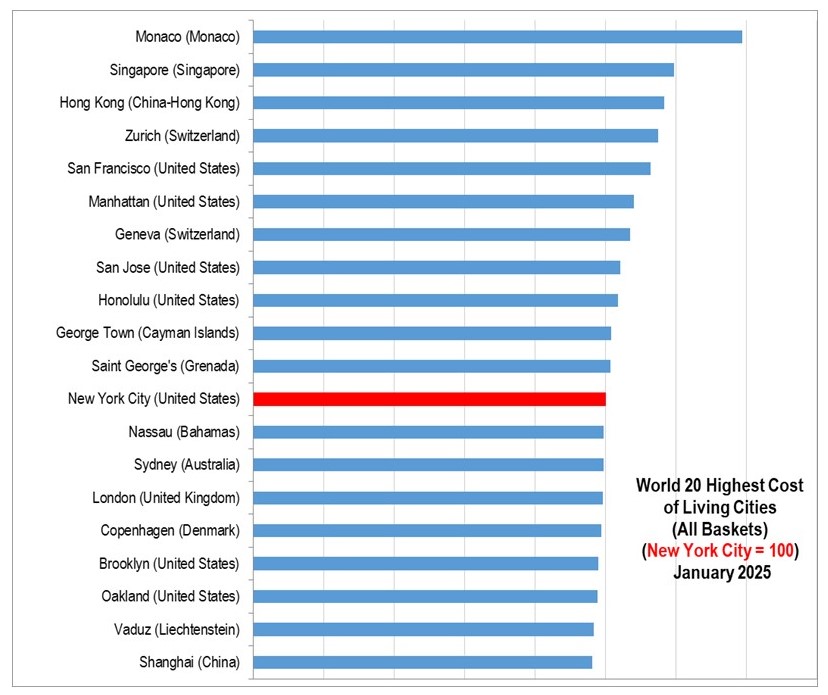
If you're an expat or considering a move abroad, one of the biggest factors in choosing a new home is the cost of living. Some cities promise high salaries and vibrant opportunities, but they also come with eye-watering expenses. The January 2025 global cost of living rankings reveal the world's priciest cities, with New York City serving as the baseline (index 100). The top 20 list includes a mix of financial hubs, tech centres, and tax havens, each with its own economic and social dynamics driving up the cost of daily life.


The World's Most Expensive City: Monaco (138.6)

Monaco tops the list with an index of 138.6, a reflection of its ultra-exclusive lifestyle. This tiny yet opulent principality attracts the world's wealthiest individuals due to its tax-friendly policies. However, its limited landmass means real estate prices are among the highest on the planet, pushing the cost of everyday living to staggering heights. Unless you're among the global elite, affording life in Monaco remains a challenge.


Singapore (119.4) & Hong Kong (116.5): High-Density, High-Cost Hubs

Singapore and Hong Kong continue to dominate as Asia’s costliest cities. Singapore’s meticulous urban planning ensures efficiency, but space constraints drive housing costs sky-high. Meanwhile, Hong Kong's geopolitical challenges and limited land make property prices nearly unattainable for many expats. While both cities offer incredible career opportunities, the price of convenience and connectivity is steep.


Zurich (114.9) & Geneva (106.9): The Swiss Standard of Living

Zurich and Geneva represent European stability and affluence. These cities boast strong currencies, high salaries, and world-class public services, but they come at a price. Zurich, as a major financial hub, and Geneva, home to international organisations, attract a wealthy workforce, ensuring that rents and day-to-day expenses remain high. Expats moving here should prepare for significant housing costs, even if the quality of life is unmatched.


The U.S. Tech Boom: San Francisco (112.8), Manhattan (107.9), San Jose (104.1), Honolulu (103.4)

Tech-driven cities in the USA like San Francisco and San Jose have become synonymous with high salaries and equally high living costs. Silicon Valley’s dominance fuels relentless demand for housing, outpacing supply and driving up prices. Meanwhile, Manhattan remains one of the most desirable locations in the world, with exorbitant rent and service costs. Honolulu, though not a tech hub, has its own unique challenges—its remote location inflates import costs, making everything from groceries to fuel significantly pricier.


The Caribbean's Costly Charm: George Town (101.5) & Saint George’s (101.4)

Paradise comes at a price. George Town in the Cayman Islands and Saint George’s in Grenada rank among the most expensive cities due to their dependence on imports and thriving tourism industries. George Town’s financial services sector attracts wealthy professionals, driving up prices, while Saint George’s—though smaller—also struggles with high costs of goods. These islands might be ideal for affluent retirees, but middle-income expats may find expenses restrictive.


Sydney (99.4) & London (99.1): Global Icons with Premium Price Tags

Sydney and London offer world-class professional and cultural experiences, but affordability is another matter. Sydney’s housing market continues to be a challenge, influenced by foreign investment and limited space. London, slightly lower in ranking, still grapples with expensive accommodation and transport costs. Expats looking to enjoy the perks of these cities should be prepared for a hefty financial commitment.


Copenhagen (98.8) & Vaduz (96.7): European Efficiency at a Cost

Copenhagen and Vaduz embody European efficiency with high taxes balanced by exceptional public services. Copenhagen’s social welfare system ensures a strong safety net, while Vaduz benefits from Liechtenstein’s wealth and prudent fiscal policies. Both cities offer excellent quality of life, but expats should brace for high living expenses.


Shanghai (96.2): China's Rising Economic Powerhouse

Rounding out the top 20 is Shanghai, a city that epitomises China’s rapid urban transformation. Its booming economy and influx of foreign talent have driven up living costs, especially in housing. While it remains an attractive destination for ambitious expats, the financial demands of city living are increasing year by year.


Is Your City on the List?

The cost of living rankings highlight the growing economic divergence between global cities. Whether you're considering a move for work, lifestyle, or adventure, understanding the financial landscape of your destination is crucial. Some cities offer incredible opportunities but require deep pockets, while others provide a more balanced cost-benefit equation.


Would you move to one of these cities despite the high costs? Let us know your thoughts!

Sunday, October 6, 2024

Europe Cost of Living Comparison October 2024

Monaco retains its position as the most expensive city and country to live in as at October 2024, not only in Europe but also globally, with a Cost of Living Index (COLI) of 138, where New York City is the baseline at 100. Monaco is 22 points pricier than the second most expensive city globally, Singapore.

In Europe, Switzerland secures the next two spots with Zurich and Geneva. Zurich, with an overall COLI comprising all 13 baskets of 114, and Geneva, at 106.

The cities topping this list share a few common traits. Limited housing availability, limited space, high-quality living standards, and robust economies keep them expensive. For places like Monaco, it's also about the prestige and tax advantages attracting high-net-worth individuals.


The Bank of England has raised interest rates multiple times to curb inflation in the UK, creating a higher yield environment for investors, which attracts capital flows to the pound. With the strengthening of the British Pound against the US Dollar, cities in the UK have become more expensive when the prices of the over 200 items in 13 different cost of living baskets are priced in USD. As a result cities in the UK are climbing higher in the global cost of living rankings. Despite their rise, cities in the UK remain 20-30% cheaper than New York, while London is just 2% cheaper than New York.

Read More

Thursday, October 3, 2024

Africa Cost of Living Comparison 2024

The contrast between the local cost of living and the expatriate experience in Africa is stark. While the continent offers an array of opportunities and experiences, the financial aspect of living here can't be overlooked. Understanding the factors that contribute to the high cost of living in these cities can help expatriates prepare for their African adventure. Whether it's for work or the lure of experiencing life on this diverse continent, navigating the costs wisely can make all the difference.

Despite Africa being home to some of the world's poorest countries with low local living costs, expats face a different reality. The lifestyle international workers are accustomed to comes at a high price here. Why? Well, it's mostly because of the need to import goods, secure safe housing, and access international standard schooling. All these factors drive up living costs significantly.

As at October 2024, the latest global cost of living rankings from Xpatulator.comMonrovia has the highest expat cost of living in Africa, followed by Libreville and N'Djamena. The prices for over 200 goods and services is collected globally in 780 locations and used for international assignment salary calculations and global mobility compensation planning

Nigeria continues to experience a sharp decline in global cost of living rankings for October of 2024, particularly in cities like Abuja, Lagos and Kano. The international cost of living index for Abuja has plummeted from 88.5 in October 2023 to 66.7 a year later in October 2024, using the prices for over 200 items, in 13 cost of living baskets, priced in US Dollars for global comparison. The root of this decline can be traced to the volatility of the Nigerian naira, unleashed by the government's decision to ease currency controls in June 2023. This move sent shockwaves through the economy, leading to foreign exchange reserves hitting a six-year low by December 2023. The naira itself ranked as the third worst-performing global currency of 2023. A backlog of unsettled forwards, undelivered promises of dollar inflows, and a two-decade peak in inflation exacerbate the already precarious situation.

Read more


Wednesday, April 10, 2024

The Most Expensive Cities in the World April 2024

The latest Worldwide Cost of Living survey conducted by Xpatulator in April 2024, covering 780 global locations, paints a picture of a global economy grappling with the aftermath of the pandemic as many locations continue to experience a relatively high cost of living at the start of 2024. Despite some relief from the peak of inflation, economists caution that challenges persist, and inflation risks loom large on the horizon.

Monaco retains its status as the most expensive international location in 2024, boasts an overall Cost of Living Index (COLI) of 138 (New York = 100). Housing costs, constituting approximately 30% of overall living expenses, remains a significant contributor to Monaco's top position. Limited space, the presence of many high-net-worth individuals, economic security, a favourable tax system, and a luxurious lifestyle all converge to elevate property prices to unprecedented heights. Monaco's overall cost of living is a staggering 21.6 points higher than second-placed Hong Kong.

Hong Kong clinches the second spot with a COLI of 116.5, primarily driven by exorbitant housing costs due to limited space. Singapore secures the third position with a COLI of 115.3. The city-state's renowned education system, combined with high housing costs and an intricate Certificate of Entitlement system driving up car prices, places Singapore among the top contenders for the most expensive locations for expatriates.


In
Africa, Monrovia in Liberia is the most expensive City, followed by Libreville in Gabon and N'Djamena in Chad.

In the Americas, California has two locations in the top three. San Francisco is the most expensive City, followed by Manhattan and San Jose. 

In Asia-Pacific, Sydney is third after Hong Kong and Singapore.

In Europe, Zurich is second after Monaco, followed by Geneva in third.

In the Middle East, Jerusalem is the most expensive, followed by Abu Dhabi, and Dubai.


Wednesday, March 20, 2024

Cost of Living in Europe 2024: Wallet Wonders and Wallet Woes

Imagine packing your bags and jetting off to some of the world's most talked-about cities, only to find that your wallet might need a bit more heft than anticipated. Let's dive into the globe-trotting adventure of living costs around the world, where the plot thickens in places like Hong Kong and Singapore, and twists await in Europe's storied streets.


Monaco, perennially perched atop the summit of extravagance, retains its crown as the most expensive location for expatriates in 2024, both within Europe and globally. The Cost-of-Living Index (COLI) of 137 (with New York set as the benchmark at 100) reflects a reality where the affluent principality continues to defy gravity in terms of living costs. Housing expenses, constituting approximately 30% of expatriates' overall living expenditures, stand out as a significant contributor to Monaco's exalted position. The convergence of limited space, an abundance of high-net-worth individuals, economic security, a favourable tax system, and a lavish lifestyle collectively propel property prices to unprecedented heights. Monaco's overall cost of living is a staggering 21 points higher than its closest contender, Hong Kong, which claims the second spot on the global stage.


Hong Kong, with its towering skyscrapers and breathtaking views, clinches the title of the runner-up in the global cost-of-living league, boasting a score of 116. The culprit? Sky-high housing prices, thanks to the city's battle with the squeeze for space. Not far behind, Singapore secures the third spot with a score of 113. This city-state, known for its cutting-edge education and high-flying lifestyle, also has a penchant for pricey homes and cars, the latter courtesy of a complex car ownership scheme.


Europe's own Zurich steps up as the continent's second priciest city, scoring 112.7, with Geneva hot on its heels. The Swiss cities' blend of strong currency, high wages, and costlier nibbles and giggles push the cost of living up the alps. These cities showcase the dance of economics, currencies, and local vibes in setting the living cost tempo.


Meanwhile, Greece is making headlines with Athens leaping an astonishing 54 spots to the 483rd position worldwide. This might sound alarming, but it's a jump from a lower springboard, and Greece still keeps things relatively affordable compared to its European neighbours.


Turkey's cities, too, are making strides, climbing 35-40 spots from their own modest starting points. Yet, they linger in the 600s out of 780 spots, amidst a backdrop of an economy on a rollercoaster ride of inflation and bold financial manoeuvres.


Russia, on the other hand, presents a saga of decline in the cost-of-living ranks, with challenges like dwindling resources, brain drain, and vanishing investments painting a grim economic scene. This scenario is spurring a push for higher wages, which in turn nudges prices upward.


The Netherlands tells a tale of descent as well, with Rotterdam taking a significant tumble down 83 spots to rank 394th globally. The once expensive Dutch lifestyle for expats now seems a tad more attainable, following a year of economic slowdown.


So, for those dreaming of an overseas escapade, these insights into the cost of living across the globe might just be the compass you need to navigate your financial planning. Whether it's the allure of Asian megacities or the charm of European life, knowing where your money might stretch or squeeze is key to a smooth landing in your new home away from home.


For More

Tuesday, March 5, 2024

Cost of Living in Africa 2024

Monrovia in Liberia, has ascended to claim the title of the most expensive city for expatriates in Africa for the first quarter of 2024. A remarkable surge of 155 places catapulted Monrovia to the 33rd most expensive location globally. This unprecedented ascent is attributed to a complex interplay of factors, with currency appreciation against the US Dollar and demand constraints taking centre stage. Liberia's import-reliant economy, where prices of almost all imported items are quoted in US dollars, exposes expatriates to the brunt of inflated costs.


Nigeria, an economic powerhouse in the region, experiences a sharp decline in global cost of living rankings for the first quarter of 2024, particularly notable in cities like Abuja. The cost of living index for Abuja plummeted from 88.5 in October 2023 to 68.7 as of January 2024.

For More


Monday, October 16, 2023

International Cost of Living October 2023

The world's most expensive cities in October 2023 shows a surge in the cost of living globally, but particularly in Europe and the United Kingdom's cost of living. The high inflation of 2022-2023 has seen real disposable income drop in more than 50% of households world-wide as salary increases have generally been much lower than inflation so far. As salary increases begin to rise, to close the cumulative gap to inflation, disposable incomes will likely remain depressed as the higher salary increases will further push up inflation and the cost of living.  

Monaco remains the most expensive city for Expats in the world with an overall Cost of Living Index (COLI), for all 13 basket groups, of 137 (New York =100) with an overall cost of living difference of 21 points higher than second placed Hong Kong.

Lagos and Abuja in Nigeria are the most expensive places in Africa. In the Americas, San Francisco and Manhattan top the rankings. In Europe, Monaco is followed by Zurich and Geneva, while in Asia Pacific, Hong Kong is closely followed by Singapore.


Country-State Cost of Living


The America's Cost of Living


Europe Cost of Living


Monday, May 8, 2023

International Cost of Living - Q2 - 2023

Hong Kong remains the most expensive city for Expats in the world with an overall Cost of Living Index (COLI), for all 13 basket groups, of 123 (New York =100). This is due to a number of factors, including the high cost of housing, the high cost of food, the high cost of transportation, and the high cost of education.

Hong Kong has one of the highest housing costs in the world. The average price of a home in Hong Kong is over HK$10 million (US$1.2 million). This is due to a number of factors, including the limited supply of land, the high demand for housing, and the government's strict land use regulations.

The Hong Kong dollar is pegged to the US dollar, which means that its value is very stable. This makes it a popular destination for foreign investment, which drives up the cost of goods and services.

Hong Kong has a relatively high tax rate, which also contributes to the high cost of living.

Hong Kong is a very small city, with a population of over 7 million people. This means that there is limited space for housing, businesses, and other infrastructure. This drives up the cost of everything, from housing to transportation to food.

The strength of the US Dollar has pushed locations in the USA up the global most expensive rankings. Manhattan and San Francisco are the second and third most expensive places in the world for expatriates to live. 

Housing costs in the United States are some of the highest in the world. This is due to a number of factors, including a strong economy, limited land supply, and a high demand for housing.

Healthcare costs in the United States are also some of the highest in the world. This is due to a number of factors, including a private healthcare system, high administrative costs, and high drug prices.

The cost of education in the United States is also high, especially at the college level. This is due to a number of factors, including the high cost of tuition, room and board, and books.

The cost of transportation in the United States is also high, especially in major cities. This is due to a number of factors, including high gas prices, tolls, and public transportation fares.

The cost of food in the United States is also high, especially in urban areas. This is due to a number of factors, including high transportation costs, high labour costs, and high food safety standards.

The overall cost of living in the United States can vary depending on the city or state in which you live. However, in general, the United States is a more expensive place to live than many other countries around the world.


Tuesday, January 3, 2023

International Cost of Living - January 2023

The first international cost of living rankings for 2023 reveal that the most expensive countries / states are dominated by those with, or with a fixed rate to, the US Dollar.

The top 10 most expensive country/states in the world for an Expat as at January 2023 are as follows:

1. Lebanon

2. Hong Kong

3. Cayman Islands

4. Singapore

5. Monaco

6. Hawaii

7. Angola

8. Switzerland

9. Israel

10. Bahamas

Lebanon is the most expensive country-state in the world as a result of years of state corruption, waste and unsustainable financial policies. The Lebanese pound has crashed, driving up prices and decreasing purchasing power, as Lebanon is an import dependent country.


For more


Wednesday, July 6, 2022

International Cost of Living - July 2022

Singapore has pulled further ahead of Hong Kong to remain the most expensive city in the world for Expatriate’s to live, with an overall cost of living index of 130 as at 1 July 2022. Hong Kong is remains the second expensive city in the world with an overall Cost of Living Index (COLI), for all 13 basket groups, of 125 (New York =100). Singapore and Hong Kong have an overall cost of living difference of 5 points, well above Manhattan the third most expensive city. 


Within each region of the world the cost of living as at 1 July, where the cost of living index for New York City is 100 is as follows: 

Africa Cost of Living


America Cost of Living


Asia Pacific Cost of Living


Europe Cost of Living


Middle East Cost of Living


For more go to Xpatulator

Monday, April 4, 2022

International Cost of Living - April 2022

Singapore is the most expensive city in the world for Expatriate’s to live, with an overall cost of living index of 128. Singapore's education system, which is widely regarded as the best in the world, is also the most expensive for expatriates when priced in US Dollars, the cost of housing is also extremely high due to the limited space and premium on high quality expatriate accommodation, while the complex Certificate of Entitlement system makes car prices excessive, resulting in Singapore’s transport costs being amongst the highest in the world.


Victoria in the Seychelles is the most expensive city in Africa for Expatriate’s to live, with an overall cost of living index of 83.


Manhattan is the most expensive city for Expats in America with an overall Cost of Living Index (COLI), for all 13 basket groups, of 117 (New York =100).


Hong Kong is the second most expensive city in Asia Pacific for Expats with an overall Cost of Living Index (COLI), for all 13 basket groups, of 126 (New York =100), mainly due to extremely high housing costs (which counts for around 30% of the overall cost of living for most Expats), with limited space available making rentals high.


Zurich is the most expensive city in Europe for Expatriate's to live with an overall Cost of Living Index (COLI), for all 13 basket groups, of 108 (New York =100).


Beirut is the most expensive city in the Middle East for Expatriate’s to live, with an overall cost of living index of 111.